Insight: What’s next for the UK’s town centres?
Share Article
The role of the town centre has fundamentally changed.
That’s almost a banal statement in 2026, where the high streets of today bear little resemblance to the those of the early 2000s. Historically, retail was the anchor that brought footfall in and everything else existed to support that primary purpose. Fast forward a decade and that model isn’t fit for purpose anymore. Internet shopping had already changed the playing field and the pandemic only accelerated it further.
So, what purpose do town centres now serve in 2026?
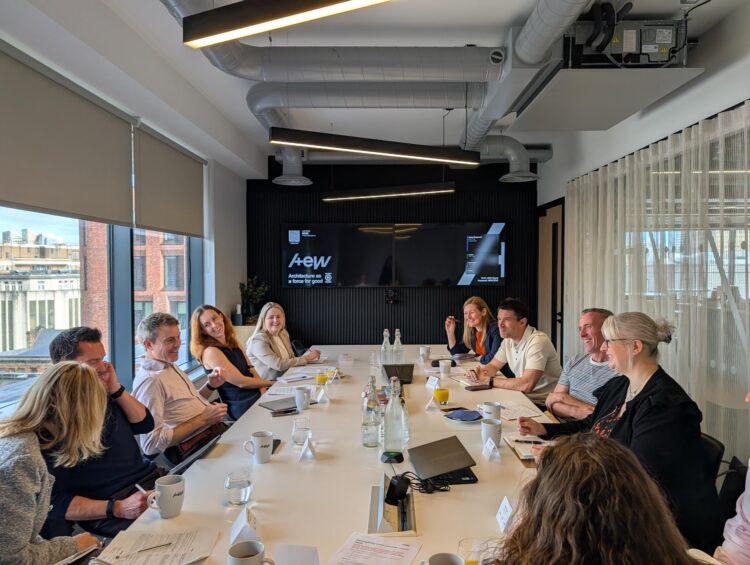
That was the starting point for our recent round table facilitated by Invest Manchester. We brought together voices from across the public and private sectors to explore what’s working, what’s challenging and what comes next for town centres across the North West.
The long and short of it was that there isn’t one single replacement that’s going to do everything retail once did. We simply don’t live in that kind of world anymore. In this article, we’ll explore some of the main talking points.
Let’s get into it.
Place has to inform regeneration
If regeneration doesn’t respond to place, you’re scrambling in the dark.
The decline of the traditional retail-led model creates an opportunity to move away from the uniformity that characterised many town centres and shopping centres in previous decades. Different towns have different communities, economies, histories, assets and challenges, so why not celebrate those unique attributes and reflect them in the regeneration strategies.
It requires more discovery work, like understanding why people use a town centre, what they value and what they feel is missing. You can’t simply try to replicate what has worked somewhere else. What’s good for Stockport isn’t necessarily good for Bolton and vice versa.
The answer for each location might be residential, health, education, culture, workspace or evening economy. We have to be agnostic until we have good information to go on.
The increasing importance of public realm
Public realm, connectivity and green space matter much more than they once did.
As we’ve seen in Stockport, interventions like the transport interchange can provide the catalyst for regeneration, but its impact depends heavily on what surrounds it. Can people move easily between different parts of the town centre? Does the route feel safe? Is there somewhere to sit, meet, play or simply spend time without having to buy something?
Good public realm can be difficult to capture on a conventional development appraisal because its value isn’t necessarily contained within a single plot. Yet it can create the conditions that make investment elsewhere more attractive.
You can apply a similar argument to green space. Parks and planting require land, investment and ongoing maintenance. Taken in isolation, a developer might fail to see the commercial case for it. But by taking a holistic view, you can see how they make town centres more attractive places to live, work and visit. They bring together different people and help create the sense of place that regeneration is ultimately trying to achieve.
Bringing homes back to the town centre.
Bringing more people to live in town centres is already playing a significant role in regeneration. At the turn of the Millenium, there were around 10,000 people living in Manchester city centre. Today, that figure is more like 100,000. That brings its own benefits and opportunities. More residents can support shops, leisure, hospitality and services throughout the day and into the evening, precisely because they aren’t commuting back to the suburbs after they’ve finished a shift.
So why don’t we just deliver more homes?
If regeneration only delivers homes at one tenure or price point, there’s a risk that town centres become less representative of the communities around them. A genuinely mixed town centre needs different types and tenures of housing, including affordable and social homes, alongside the infrastructure and services that residents need.
We have to consider the importance of the whole rather than schemes in isolation. One development might deliver market rented homes, another affordable housing and another a civic or cultural use. That collective contribution will shape the town centre for the better.
Viability is the elephant in the room
The built environment never lacks for ambition. But commercial reality can be brutal.
Outside prime city-centre locations, the viability gap remains significant, and the more complex town centres become, the more complicated the funding picture can be.
Of course, public-private partnerships have a big part to play. This is a talking point that always gets a lot of airtime in discussions around viability, but what often gets left out is the quality of that collaboration. Something that really matters is how early that collaboration begins and whether everyone around the table understands what is genuinely deliverable.
Local authorities can provide direction through clear, responsive frameworks and strategic investment. The private sector can bring market knowledge, development expertise and alternative approaches to delivery. Operators, housing providers, health bodies, educational institutions and community organisations may all need to be involved much earlier too.
Communities need to be listened to
If town centres are becoming more complex, we should look to the people who will be using them before deciding what we do with them.
Running a consultation shouldn’t become a statutory exercise you do when you’ve already made the important decisions. There’s huge value in involving residents, businesses, community groups and other local stakeholders early, then maintaining that relationship as a long-term regeneration programme evolves.
Local knowledge can expose priorities that wouldn’t necessarily be obvious to someone approaching a place from the outside. Community-led conversations can produce very different definitions of what is valuable, what is missing and what needs to change.
It also creates trust. Regeneration can take years or decades, during which market conditions, funding programmes and political priorities will inevitably change. Starting out with a clear vision is obviously important, but of equal importance is the flexibility to adapt that vision without losing the support of the people it’s intended to benefit.
Think beyond practical completion
One of the most important things to consider is timescale.
Regeneration will be judged, not on what gets built but on what comes afterwards.
Does the town centre continue to evolve? Can buildings adapt as needs change? Are public spaces affordable to maintain? Do community assets remain useful? Has investment created opportunities for local people? And does the place still feel like it belongs to the community that was there at the beginning?
The strongest town centres will be those designed not only for today’s requirements, but with enough flexibility to accommodate uses we haven’t anticipated yet. The same principle applies to the wider regeneration strategy. Rather than trying to create a finished town centre, the aim should be to establish the conditions in which a place can continue to change successfully over time.
The bottom line
There’s no universal blueprint for what comes after retail, and that may ultimately be a good thing.
The opportunity now is to create town centres that are more distinctive, more useful and more closely connected to the communities they serve. We need commercial realism, long-term thinking and partnerships capable of looking beyond individual sites and funding cycles.
If we get it right, our high streets will be in a position to thrive while providing benefits for all.
Thank you to Invest Manchester for facilitating the roundtbale, and to our guests Catherine Chilvers (Stockport Mayoral Development Corporation), Danny Crump (Layer.studio), Helen O’Doherty (Bolton Council), Nick Mullins (AXIS-RE Ltd), Euan Kellie (Euan Kellie Property Solutions), Emma Barton (Oldham Council), Paul Roberts (Hive Projects), Sabine Dunstan (CBRE UK) and Paul Cook and Emily Brain (Willmott Dixon) for joining the discussion.