Insight: Fire & Ice – Finding Building Safety Balance in Retrofit Projects
Share Article
Over the past few years, we’ve honed our expertise in fire safety, integrating rigorous compliance into every project we deliver. The Grenfell tragedy changed everything, forcing the sector to confront the consequences of poor design, weak regulation, and misplaced trust in products that didn’t perform.
Since then, the focus on compliance has been relentless. Every detail of a façade system, every cavity barrier, every insulation layer now faces more scrutiny. The Building Safety Act (BSA) has shifted the industry from box-ticking to true accountability. As a practice, we’ve embraced the BSA to ensure the ongoing fire safety of our projects.
But there’s another battle we should be paying just as much attention to. The battle against cold, damp and unhealthy homes.
The quiet crisis behind the headlines
The End Fuel Poverty Coalition, estimates that nearly 5,000 people died in the UK in 2022/2023 because of cold homes. That’s thousands of preventable deaths due to a failure to keep buildings warm and dry.
Recent UK policy developments underline the human and legal imperative to tackle cold, damp and mouldy homes – not just as quality-of-life issues, but as enforceable housing standards. Awaab’s Law, introduced in October 2025 following the death of two-year-old Awaab Ishak from mould-related illness, requires social landlords in England to investigate and address hazards like damp and mould within strict timeframes, with emergencies dealt with immediately. The legislation makes clear that poor insulation, inadequate ventilation and ineffective moisture management are not just design shortcomings, but statutory compliance responsibilities when residents’ health is at risk.
Cold and damp homes are associated with respiratory illness, arthritis, and heart disease. They can exacerbate existing conditions, particularly for older people, and they contribute to poor mental health, social isolation, and childhood development issues. Research in Thorax from the BMJ suggested that nearly a fifth of acute respiratory admissions for children under two could be prevented if housing were free from damp and mould.
These are not abstract statistics. They’re a reflection of how the built environment impacts public health and we have the ability and responsibility to intervene.
Fire and ice: two sides of the same coin
We talk a lot about “safe homes” in the context of fire, but safety isn’t just about preventing a blaze. A home that leaves its occupants at risk of hypothermia, respiratory illness or chronic damp is not safe either.
Many of the schemes we’re delivering at AEW start as fire safety remediation projects. The briefs we receive are to make buildings safe, replace the cladding and upgrade structures to meet new standards. But once you’ve scaffolded a high-rise block, stripped back the façade, and exposed the external wall build-up, you’re standing at the perfect moment to address thermal performance, airtightness, and condensation risk.
If we don’t pay careful attention, we risk locking in underperformance.
Let’s say you’re installing external wall insulation on a remediation project. You specify 50mm insulation instead of 100mm. The building could meet today’s minimum standard, but in five or ten years, when the net zero deadlines tighten, that same wall will have to be redone. By that point, inflation has driven material and labour costs up, access scaffolding will need to be reinstated, and residents will face another round of disruption.
A ‘light-touch’ approach might save money in the short term, but it creates long-term cost and carbon inefficiency.
The economics of deep retrofit
Of course, it’s not as simple as saying “just do it”. Deep retrofit is expensive. Many social landlords operate within extremely tight financial constraints, and when the numbers show that you will be spending tens of thousands of pounds per home for a marginal increase in sales or rental value, it doesn’t look like a sound investment on paper.
That’s where funding mechanisms come in. We’ve seen positive steps through the Social Housing Decarbonisation Fund (rebranded the Warm Homes Social Housing Fund) and local authority grant programmes. The challenge is that these are usually separated from fire safety remediation funding. So, a housing association might secure finance to replace unsafe cladding under one scheme, but energy efficiency work must be financed through another, even though both involve the same envelope.
Where clients have been able to “stack” these funding streams – blending fire safety and decarbonisation grants into a single scope of works – the holistic results have been much more successful. You can deliver compliant façades that are also highly insulated, airtight and future-ready. It’s exactly the kind of joined-up thinking we need to reach both safety and sustainability goals.
At the same time, the UK Government’s new Warm Homes Plan – a £15 billion programme to upgrade up to 5 million homes with measures like insulation, heat pumps, solar panels and draught-proofing – signals a positive commitment to affordable warmth and healthier indoor environments.
Learning from the projects
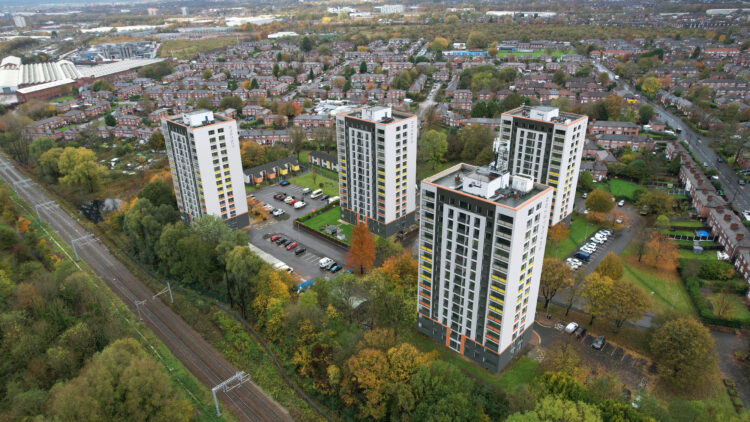
Take our Croydon Drive project for Manchester City Council. The project began as a fire remediation job after combustible insulation was discovered in the existing façade system. Once the unsafe materials were stripped away, the opportunity arose to rethink the building envelope, improve energy efficiency, and give residents a healthier internal environment.
The scheme now includes upgraded insulation, non-combustible materials throughout, and improved architectural detailing that references the site’s aviation heritage. As well as safety, this project was about improving quality of life, appearance, and performance in one go.
We’ve also been supporting smaller, lower-rise retrofit programmes across the North West. These might look simple on paper – cavity wall refills, loft insulation, solar PVs – but they still require precise detailing to avoid thermal bridging and condensation risk. Even the “light-touch” end of retrofit needs coordination between designers, retrofit coordinators, retrofit assessors, and installers to make sure the measures don’t create new unintended consequences down the line.
Managing complexity
Retrofit now sits at the intersection of multiple regulatory regimes. Designers must navigate PAS 2035 requirements alongside the Building Safety Act, Gateway approvals, Golden Thread information and new duty holder roles. This growing overlap between safety and sustainability legislation reinforces a simple truth: fire performance, thermal performance and moisture behaviour can’t be considered separately. Every design decision affects all three.
The cost of doing nothing
If the case for deep retrofit feels abstract, it’s worth remembering the social and economic cost of inaction. A BRE study suggested, the NHS spends over £1 billion a year treating people affected by poor housing.
Beyond health, there’s also the human cost of living in discomfort. Parents choosing between heating and food, older residents isolated in single heated rooms, and children missing school due to ill health. When you start to see those outcomes as extensions of design decisions, it changes how you think about architecture.
Making every project count
We don’t always have control over funding, but we do have influence over approach. When we’re brought in on a remediation scheme, we ask: what else can we achieve while we’re here? Can we combine scopes, integrate funding, or coordinate the retrofit assessment early enough to make meaningful upgrades?
Sometimes it’s as simple as making sure the details are right, like properly aligning insulation, addressing cold bridges, or specifying materials that manage moisture rather than trap it. Small decisions can make a big difference to long-term building health.
We also recognise that retrofit is a social exercise as well as a technical exercise. Many of our projects are resident-led, involving people in the process so they understand what’s happening to their homes and why. That engagement helps build trust and leads to better outcomes.
Fire, ice, and everything in between
Let’s remember, that building safety has two faces. Fire is the visible risk; cold is the invisible one. Both can endanger lives, and both deserve attention in how we design, manage, and deliver retrofit, refurbishment and remediation projects.
We can’t always solve every problem at once. Budgets are finite, timescales are tight, and compliance frameworks are still evolving. But every time we touch a building, we have an opportunity to do more than just make it safe. We can make it sound. We can make it healthy. We can make it ready for the future.

Written by: Danny Lomax, Architect & Retrofit Coordinator