Insight: What Delivering Our First Passivhaus Scheme Taught Us
Share Article
As an international building standard, Passivhaus forces architects to be ambitious about what they can achieve. As we discussed in our previous article, Why business as usual won’t get us to net zero, the Part L regulations simply won’t help us reach net zero targets.
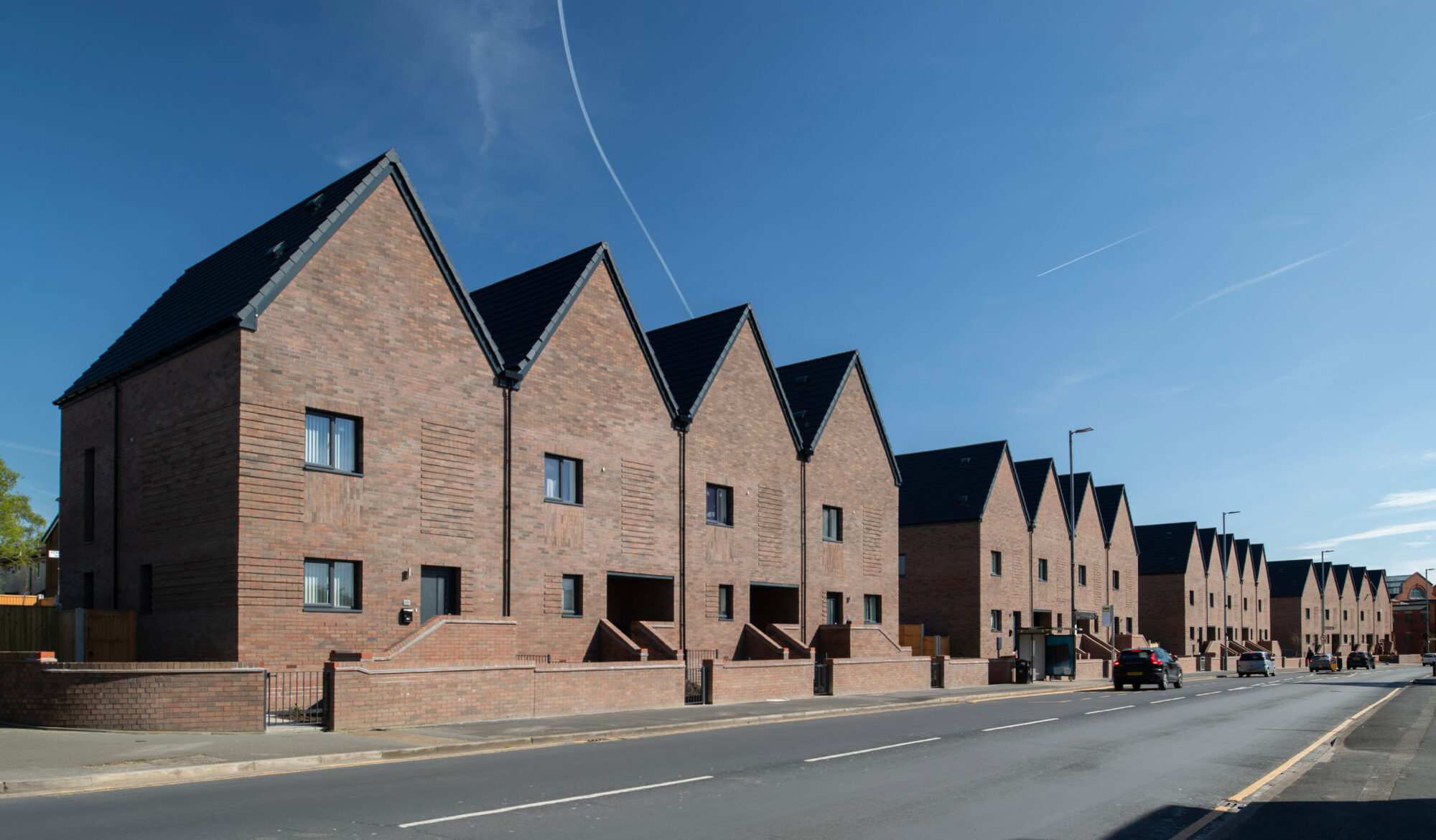
In that article, we set out what was needed for a Passivhaus approach to be successful. Since then, construction has wrapped on our first full Passivhaus scheme – Parkmount, Harpurhey – so we thought it was time to return to the subject and talk about what we learned.
The big takeaway isn’t surprising. Passivhaus isn’t a simple design decision, but a shift in how you think, coordinate and deliver buildings from day one.
With the recent launch of the Government’s Future Homes and Buildings Standard (FHBS) – setting out a requirement for all new homes to be “zero-carbon ready” from March 2027 (with transitional arrangements) – the knowledge from Passivhaus schemes like Parkmount is more important than ever.
Let’s get into the details.
It’s tricky to retrofit Passivhaus thinking into a design
One of the biggest lessons came when we made the decision to pursue Passivhaus.
The challenge was that the scheme didn’t start out as a Passivhaus design.
The brief evolved late, just before planning, when the client asked whether we could take it to Passivhaus standard. At that point, the layout, massing and orientation were already largely set but we took on the challenge.
We worked hard to embed the principles into the scheme, and we achieved strong outcomes. But it did make the process more complex.
Passivhaus relies on early decisions. Orientation, form, window strategy, servicing routes and junction detailing all play a part. When those decisions are already locked in, you’re not designing freely and working around constraints you otherwise wouldn’t be.
If you’re serious about performance, we learnt you need to commit to it from day one to remove needless friction from the design process.
Fabric first
We talk a lot about fabric first in the industry, but when working to Passivhaus standards, that importance is magnified tenfold.
At Parkmount, we drilled down and focused on the basics: continuous insulation, airtightness, and eliminating thermal bridges. A key lesson we learnt here was the need to draw clear insulation and airtightness lines through all our details, to ensure they hold up at junctions.
The fabric-first approach also meant making some difficult choices.
We reduced window sizes in places where they would drive overheating or heat loss and we simplified junctions so they could be built properly. The materials we chose were selected based on performance, not just how familiar they were to the project team.
It’s tempting to think Passivhaus is all about adding more technology, but our experience at Parkmount suggests it was more about designing the fabric to remove the need for it.
If the fabric performs, everything else becomes easier.
Airtightness lives or dies on site
You can design and detail an airtight building. Delivering one is another matter entirely.
The tolerance for error is tiny. Small gaps around service penetrations, poorly sealed junctions, or inconsistent workmanship can undo a lot of good design work.
Ultimately, you’ve got to get the contractor fully on board and work closely with them to achieve the right standard.
We also saw how sensitive the outcome is to change. Adjustments to insulation, window specifications or installation methods had a direct impact on performance and required careful reassessment.
Another lesson learnt was the need for continuity between design and construction for efforts to bear fruit. You can’t just hand the Passivhaus methodology over to the next team, you’ve got to carry it through the whole process, working collaboratively while providing guidance and support.
Orientation is important, but you’ve got some flexibility
There’s a persistent idea that Passivhaus only works on perfectly oriented sites.
In reality, we all know most sites aren’t perfect.
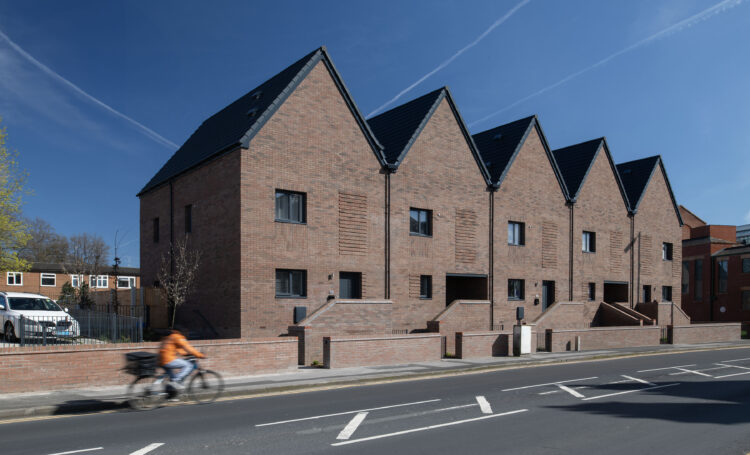
Parkmount is largely east to west facing, which isn’t ideal. It limits useful solar gain in winter and increases the risk of overheating from low angle sun in summer and this was something our design had to respond to.
We controlled glazing carefully, reduced window areas where necessary, and used façade detailing to maintain a balanced appearance. Deep reveals and careful proportions helped manage solar gain without compromising the overall design.
This isn’t a textbook scenario, but we found a way to make it work.
Good design doesn’t rely on perfect conditions. It adapts to the ones you have.
Not everything needs to be “Classic” to be worthwhile
The old adage is true: perfect is the enemy of the good.
At Parkmount, different phases of the scheme achieved different outcomes. One block reached Passivhaus Classic, while others aligned with Passivhaus Low Energy Standard.
Given the design constraints we had to work with, we didn’t see this as a failure. Our approach was successful in that it took the different blocks to the very best standard possible. Rather than forcing a uniform outcome, we focused on achieving the best possible performance across the scheme.
There’s an understandable tendency in the industry to chase certification as the end goal. What this project reinforced for us is that the real objective is the best performance possible given the site conditions and project context.
Services need to be designed
Passivhaus changes how we think about services.
Mechanical ventilation with heat recovery shapes the building in lots of important ways. Duct routes, ceiling zones and plant locations all need to be considered early.
At Parkmount, we coordinated MVHR into the design so it could operate efficiently without compromising the architecture. Short duct runs and sensible plant locations make a tangible difference to performance.
Then there’s a human factor.
If residents don’t understand how systems work, they can unintentionally undermine them. Turning systems off, blocking vents or making ad hoc changes can affect performance quickly. All of which is why, in many ways, we’ve learnt that the handover and user understanding is just as important as design.
If it’s not a team effort, it doesn’t work
We’ve touched on this already, but more than anything, this project showed us that Passivhaus has to be collaborative.
Clients, designers, contractors, consultants and certifiers all need to be aligned. Decisions made in isolation simply don’t hold up when you’re working to this level of performance.
Early engagement makes a significant difference. So does working with people who understand what’s required and why it matters.
When everyone is pulling in the same direction, the process becomes much smoother. When there’s disconnect or discord, it becomes difficult very quickly.
What we’re taking forward
Delivering our first Passivhaus scheme hasn’t given us a fixed formula to apply to every project. What it has given us is a clearer understanding of what matters.
- Start early.
- Prioritise the fabric.
- Design details that can actually be built.
- Keep the team aligned and engaged from day one.
- Focus on performance, not just certification.
The industry is moving towards lower energy buildings, whether through policy, client demand or rising energy costs. Passivhaus offers one route to get there, but the underlying lessons apply more broadly.
If we continue to treat performance as something we can layer on at the end, we’ll keep falling short.
If we design for it from the beginning, we give ourselves a much better chance of getting it right.
Written by: Dan Sutton, Architect & Certified Passivhaus Designer