Insight: The Changing Face Of Industrial Schemes Through Considered Placemaking
Share Article
In the past, industrial developments were often placed on the edge of town close to motorway networks and well away from major retail or residential areas. In many ways this gave them a kind of practical invisibility.
Today, the context of industrial schemes is changing. Demand remains strong, but the buffers may be thinner, the sites are trickier and industrial development is more visible, more urban and, in some cases, more politically sensitive.
In this thought piece, we examine the need for considered placemaking in industrial schemes, outlining modern approaches and how to do it with care, consideration and success.
Industrial placemaking and masterplanning
One of the clearest shifts in modern industrial architecture is that placemaking is no longer treated as something you bolt on at the end. It’s increasingly part of the masterplanning conversation from the start, especially on strategic employment sites.
Industrial placemaking is often a site planning discipline before it is an architectural one. The plot structure, the movement hierarchy, the landscape framework, and the way you treat edges do more to create “place” than any elevation treatment will.
The questions to ask are typically
- Can a site accommodate the required floorspace?
- Can the wider environment support it in terms of drainage and biodiversity?
- Are movement patterns workable for all?
- Are there amenities for staff?
- Does the estate stitch into its surroundings rather than operating like a sealed compound.
Handled properly, this early thinking improves the occupier offer and helps developments sit more comfortably within the wider area.
The rise of the campus
Framing large industrial schemes as campuses reflects a genuine shift in what occupiers and employees now need.
As an industry, we’ve thought about industrial projects in terms of location, location, location for a long time. The question was how far from the motorway junction is the site. But that’s not the only driver now. Labour and skills availability, power availability and viability pressures are all big considerations when designing a scheme.
Take distribution and the way it’s shifted as an example. Places that aren’t textbook optimal for the motorway network can become better choices overall because they can supply the workforce and the supporting services, and because the “place” works for staff and operators. It’s a much more holistic picture than it used to be.
Designing schemes as coherent campuses, with legible routes, safe pedestrian movement, usable landscape and considered amenity, helps occupiers attract and retain staff and creates environments that function more effectively day to day.
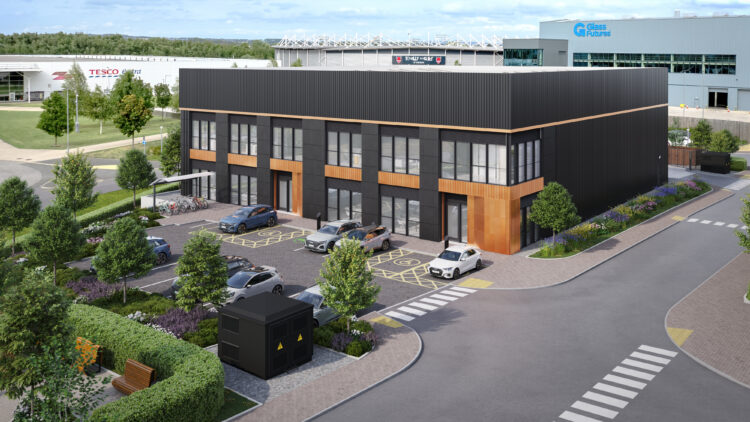
At Project Halo, St Helens, we’ve delivered a high-quality, innovative campus of four “Tech Boxes”, purpose-built to attract leading tenants and reinforce the area’s established strengths in medical technology and glass manufacturing.
BNG and SuDS as a placemaking framework
Biodiversity Net Gain and SuDS have changed how sites are planned. With both, you often have to prove why you can’t achieve them on site rather than pushing them offsite or underground. On top of that, the cost of exporting material from site can be eye-watering. Off-site BNG can be expensive and is often discouraged compared to on-site solution. Some schemes now have to “wash their face” on plot. Simply put, they have to stand up commercially and technically on their own land. That can feel like a constraint until you recognise the opportunity it creates. If you have to allocate land for BNG and SuDS anyway, the question becomes where you put it and what else it can do.
When you do BNG and SuDs well, you can use the landscape structure to define edges, shape views, create staff amenity, support active routes, and provide a softer interface between industrial form and its surroundings. Above ground, SuDS isn’t just a technical feature anymore. It becomes a visible part of the environment that can be designed to contribute to experience, legibility and identity. It also reduces the embodied carbon of schemes by having fewer underground tanks and crates with the civil engineering that they require.
That is placemaking. Not in the abstract. In a very literal, plan-led sense.
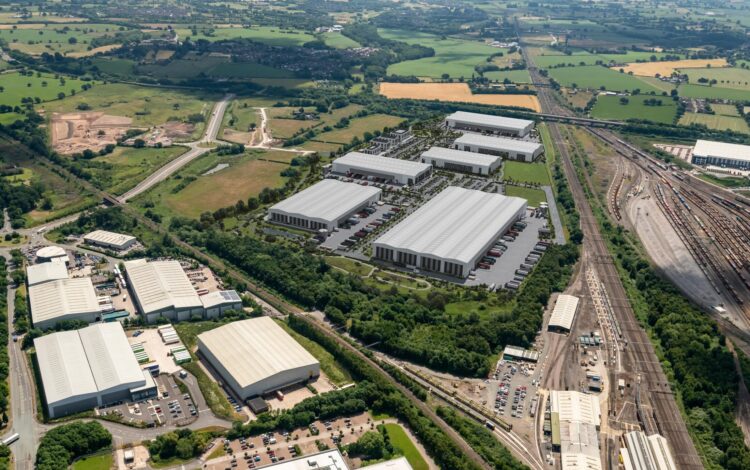
Basford East in Crewe is a good example of this. The masterplan is landscape-led and design-code informed, and the site strategy is doing several jobs at once. There is a commercial logic underneath it all, but the outcome reads as place rather than leftover land.
Design codes and standard products
Another tension that’s becoming harder to ignore is the pull between standardisation and context.
Many developers want a recognisable product. A consistent palette, a universal language and a repeatable approach. In a certain type of market, that makes sense. It speeds delivery, controls cost and creates clarity for occupiers.
But there’s a clear conflict between this approach and the increasing complexity of sites. Sites are getting more and more urban, visible, and sensitive. Trying to roll out a rigid formula on every one becomes impractical and unviable.
How do we navigate this? The practical answer is not to abandon consistency but to build in wriggle room. The best industrial placemaking comes from choosing the right tools for the site, not forcing the site to accept the same solution every time.
That toolbox can include the positioning of landscape features, elevation treatment, orientation, how boundaries are handled, and movement hierarchy. Sometimes:
- Bolder facade treatments, like our Manchester Business Park scheme, which created an office park feel on approach, focusing attention away from the more utilitarian parts of the building.
- The whole building can be expressive in colour or form if it is well separated or screened from sensitive receptors such as housing.
- The “product” can stay largely intact, but only if the landscape setting does the heavy lifting.
It’s not a binary question of “does it look industrial or not”. You can’t make a 15 to 20 metre high box vanish through wishful thinking. The real work is choosing where the budget and design effort has the most impact and being prepared to flex where context demands it.
Greenfield and brownfield can have different placemaking problems
Industrial placemaking is not a single challenge to be overcome once. It’s context sensitive and changes depending on the land type and the story of the site.
Greenfield land
The greenfield conversation centres on the on-plot requirements that shape the plan. Material retention, BNG, SuDS, and wider environmental considerations are all organising elements that affect placemaking. They’re also the things you can place strategically to produce collateral benefits, like better edges and better staff amenity, without undermining viability.
Brownfield land
The challenge with brownfield is often less about buffers getting thinner and more about explaining change. New buildings may be taller or larger, or simply different in position. But they’re also likely to perform better. Better insulated, better sealed, more controlled, often cleaner operationally than what came before.
Placemaking here becomes partly about acknowledging what existed, describing what is changing, and showing how the modern scheme is responding to a different set of standards and expectations than the old one ever did.
Protecting viability with placemaking
There’s a misconception that placemaking is the architect asking for more. More cost, more embellishment, more indulgence.
The exact opposite should be the case. If they’re doing their job right, the design team should balance competing demands to arrive at the best planning solution that ticks the commercial boxes.
Again, this is where doing your homework is essential. Having an early grasp on ecology, flood risk, ground and servicing constraints leads to a scheme that’s more deliverable, contextual and more likely to gain planning consent. Simply put, this work helps programme certainty and risk reduction.
A more mature industrial sector talks about place, not just location
As we’ve said, location will always matter.
But it’s absolutely imperative to give equal footing to place in modern industrial development. Labour markets, power, staffing, staff experience, relationships with local communities, environmental performance and landscape — these are all vital aspects that govern whether a scheme can be successful or not.
By treating these things as core design inputs, schemes should move through consent more smoothly, be easier to let, and easier to construct. When treated as an afterthought, you’ll find yourself trying to explain your way out of a problem that could’ve been solved with the proper up-front work.
Ultimately, good industrial placemaking is about making schemes more integrated with the environments they sit within.

Written by: Alan Lamb, Director